
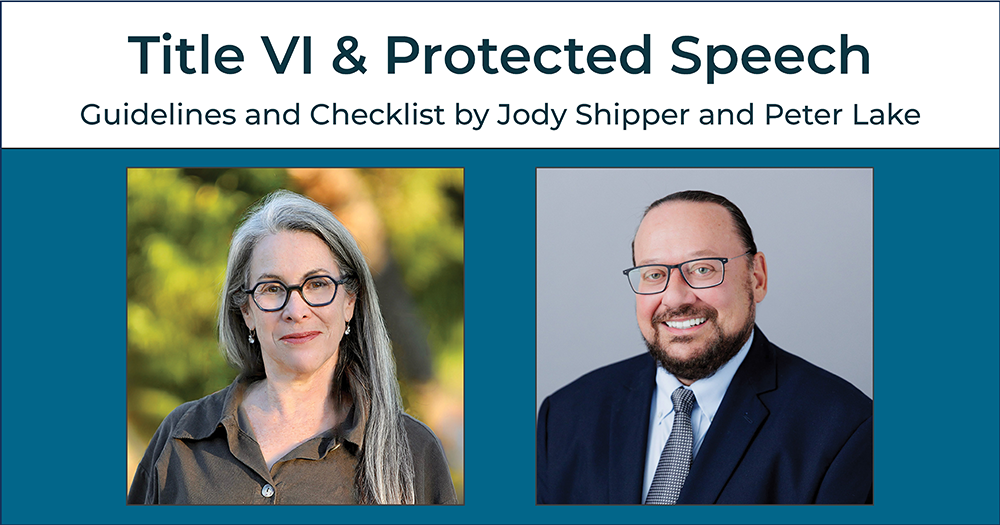
Title VI, Speech, and Expression in Higher Ed
Notes from a September 2026 webinar with speakers Professor Peter Lake, Stetson University College of Law and Jody Shipper, Grand River Solutions, and hosted by Jahanna Azarian, Grand River Solutions.
As part of their conversation, Jahanna posed a series of questions submitted prior to the webinar.
Current Legal Landscape
Peter Lake described increased federal activity around Title VI enforcement, particularly regarding antisemitism and DEI-related issues. He described a pattern he called “whack-a-mole,” where agencies issue similar directives on related topics even after litigation that resulted in findings against the initial directive. He noted that campus protest activity has decreased since the post-October 7 peak and raised the open question of whether this reflects a genuine calm or reduced willingness to speak out.
Protests and Campus Rules
- Courts have generally given institutions more latitude to restrict overnight encampments than spontaneous protests, the latter carrying deeper First Amendment resonance.
- Protests that block building access raise both safety and discrimination concerns.
- Lake recommended focusing rules on “spaces and places” rather than on specific speakers or content, noting that content-based restrictions often invite scrutiny of institutional motive.
- Shipper emphasized that protest rules should be understood and consistently enforced by all campus stakeholders (conduct, safety, faculty), rather than applied unevenly depending on the topic, or the campus office addressing the protest.
Intersectional Complaints
When asked about a scenario of an employee wanting to file a Title VI complaint alleging denial of promotion based on race and gender, Shipper cautioned against siloing Title VI, Title VII, and Title IX into separate offices or policies, noting this risks missing the intersectional nature of some complaints. She generally advised against a standalone Title VI office or policy for most institutions, while some may choose to have a Title VI Coordinator, this does not require either a separate office or a separate policy. Also, Shipper reminded attendees that New York State requires that each campus has a Title VI Coordinator, but this does not require creation of a separate office.
Chalk Message Hypothetical
Another question involved a hypothetical of a student who finds chalk graffiti referencing the IDF (Israel Defense Force). Both speakers stressed that the absence of an identifiable perpetrator or property damage does not end the inquiry — institutions must assess whether a hostile environment was created by conducting a thorough intake. Lake tied this to the importance of defining what “forum” a space (sidewalk, dorm door, linen closet) is meant for. Shipper added a strong plug for thorough intake training — making sure the person conducting intake on a case like this knows to ask about exact location, size, context (if any), other related incidents, and impact before determining whether to dismiss a complaint. Shipper also spoke of the need to carefully document the intake interview, find out if there is video or photographic evidence to gather and preserve, the rationale for deciding whether or not to move the case forward, and whether or not any supportive or preventive measures should be put in place.
Classroom Speech
Responding to a hypothetical involving a provost declining to investigate comments made in class, Lake noted the classroom is not automatically exempt from review under academic freedom and suggested starting any analysis with the course’s “content parameters” (often reflected in the syllabus). Shipper added that speech can be both protected by academic freedom and still raise hostile-environment concerns — the two aren’t mutually exclusive — and that institutions may need to consider remediation even where discipline isn’t appropriate. Both recommended having a clear, documented process for determining academic-freedom questions, and communicating that determination early to reduce misunderstanding and ill-will.
Large-Class Investigations
On investigating a 120-person class where offensive comments were made, Lake advised realistic, proportionate outreach (not necessarily interviewing every student). Shipper noted some recent resolution agreements have pushed institutions toward broader outreach — notifying entire classes of potential hostile environment and remedy options — a shift from past practice of only engaging students who self-identified as complainants. Both Shipper and Lake noted the importance of striking a balance appropriate to each specific situation.
Closing: “Peace or Silence?”
Lake closed by sharing his personal impression that campuses are seeing a mix of outcomes — more sophistication in peaceful advocacy, alongside some instances of hesitancy to speak, including concerns about retaliation via anonymous student evaluations, which he suggested may warrant reconsideration given their potential for misuse. Shipper referenced data suggesting minority and women faculty may be disproportionately targeted in negative anonymous evaluations.
The rest of the summary and the Checklist –– Takeaways for Title VI, Speech & Expression can be found here.
Conclusion
If you and your team would like to learn more about the critical issues of Title VI and Protection Speech, join colleagues and an esteemed group of national experts in Las Vegas on Oct 27 & 28 for the Free Speech and Title VI Training Symposium, co-sponsored by Stetson Law School and Grand River Solutions. See details here.
