
Clery Act Services
Clery Act | Violence Against Women Act | Stop Campus Hazing Act
Our team of experts is prepared to help your campus navigate the federal requirements for campus safety and disclosures under the Clery Act, including the Violence Against Women Act (VAWA) and the Stop Campus Hazing Act (SCHA). The Clery Act requires institutions participating in federal student aid programs to publish an Annual Security Report (ASR), maintain a daily crime log, issue timely warnings and emergency notifications, and disclose campus crime statistics. The Campus SaVE Act, enacted under the Violence Against Women Act (VAWA), amended the Clery Act to expand requirements related to sexual assault, domestic violence, dating violence, and stalking, including prevention programs, reporting options, and disciplinary procedures. The Stop Campus Hazing Act (SCHA) further amended the Clery Act by adding hazing as a Clery-reportable offense. The law also requires a biennial Hazing Transparency Report and implementation of hazing prevention policies and education.
Upcoming—Free Webinar
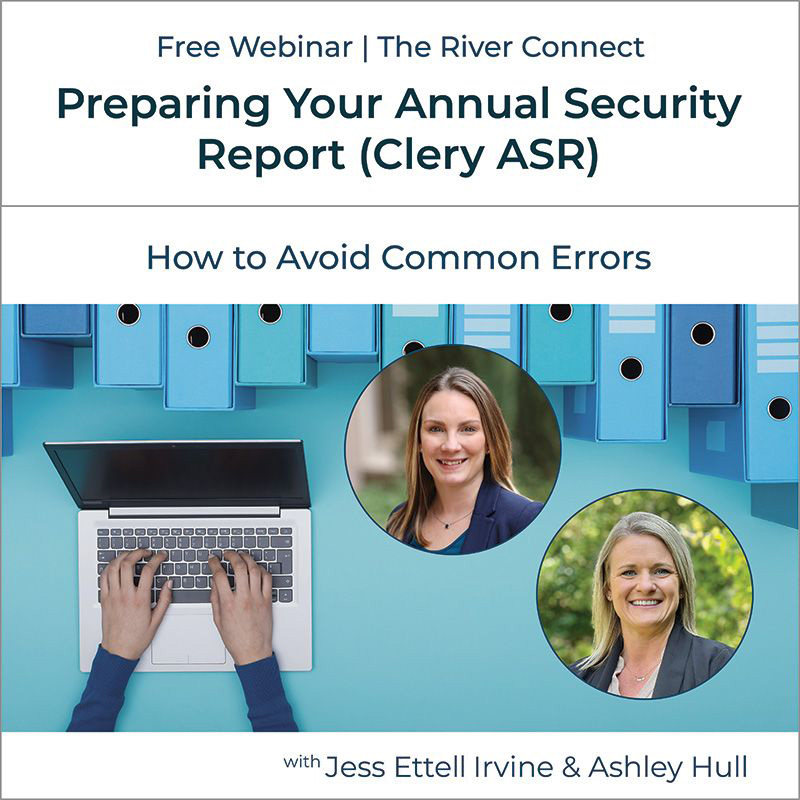
Preparing for Your Annual Security Report
with Clery Experts Jess Ettel Irvine & Ashley Hull
August 3, 2026
9:30 PT | 12:30 ET
Join our expert Clery team to learn about the most compliant and practical way to complete an Annual Security Report. Jess and Ashley will provide an overview of the most frequent errors we see institutions encounter and how to address those errors. The session will be interactive with an opportunity for questions and answers.
Every attendee gets an essential downloadable resource—The Missing Person Policy Checklist.
Choose from 3 Options
You will be assigned a project lead so you’ll be up to date on every step of the process. Each part of your ASR will be shepherded by our team members who have expertise in specific areas, from state and federal regulations to school branding.
ASR Complete (A)
Good for institutions with one or few campuses. Our multi-disciplinary team of practitioners and designers will organize data, provide updates and review for compliance, recommend policy and process changes, and design and deliver a final completed report, ready for you to distribute.
ASR Complete (B)
Multi-Campus
Same as ASR Complete but designed for schools that need multiple reports. We employ cloud-based, secure software designed to bring stakeholders together in one centralized workspace to streamline your ASR development and review process with more collaboration, efficiency, accuracy, and accountability.
ASR Complete (C)
Your Design
This option is for institutions who wish to create their own layout and design. Users can use our cloud-based, secure software with their own structure, audit trails, and verifications. Our team provides product support for your use of the software, including initial set-up, orientation/training, and troubleshooting.
Clery Consulting
Our experts are available to answer questions about case-specific incidents, geography, timely warnings, and emergency notifications. Whether it’s a one-time question, ongoing support, or your institution needs a review of practices or a development of new processes, each solution is customized according to institutional needs while following Clery Act and Stop Campus Hazing Act guidelines and best practices.
Other Services
Data Reconciliation
Our team will ensure the integrity of crime classification and incident reconciliation to increase accuracy and reduce the risk of over or under reporting in your ASR. The process includes a comprehensive review of incident reports in your Case Management system, review of reports from the University Police Department/Public Safety, and reconciliation of all campus reports with local law enforcement records.
Campus Security Authority Tracking
Campus Security Authority (CSA) Training and Tracking: Utilizing our cloud-based software, we can help you organize your CSAs, track their certifications of participation, and provide real-time feedback to you about their knowledge levels of the training.
Compliance Program Review
Our legal and compliance experts review and provide recommendations on your policies and procedures to achieve best practice and innovative solutions. You can trust us to ensure all mandates required for compliance with the Clery Act, VAWA, and Stop Campus Hazing Act are met while we work closely with other institutional compliance partners to find synergy with all campus policies and needs.
What to Know About Clery | VAWA | Stop Campus Hazing Act
In January 2025, the 2024 Title IX regulations were vacated, and institutions resumed operating under the 2020 Title IX rules, emphasizing formal grievance procedures and a narrower definitions of harassment. Under the auspices of Title IX, the Department of Education considers a school’s decision to treat someone consistent with their gender identity as possible sex discrimination; for example, ED says that allowing transgender women to compete on women’s sports teams is discriminatory against women. Recent agency activities, including in Maine, New York, and Minnesota, reflect the ongoing efforts of this administration to eliminate protections for students based on gender identity and to reject that gender identity is a protected.

Essential Resources
SCHA Analysis & Checklist
Our team is led by top experts on Title VI, Title VII, and Title IX. We've travelled the route of shifting regs and complex environments and can help steer the path when things get challenging. We are proud regs wonks who pour through legal cases and analyze trends—so you don't have to.
Guide to Clery Act | VAWA | SCHA Compliance
The List
The Tools
- Review and refine policies and procedures for responding to domestic violence, dating violence, sexual assault, and stalking in alignment with VAWA amendments. Make sure there is clarity between the intersecting requirements of VAWA and Title IX, including employee training, procedural rights of the parties, and more.
- Ensure timely warning and emergency notification systems are current, tested, and backed by clear written procedures that meet legal requirements.
- Strengthen collaboration between campus safety, Title IX, student conduct, HR, housing, and local law enforcement to support accurate reporting and coordinated responses.
- Ensure supportive measures, reporting options, and complaint processes are clearly communicated, trauma-informed, and accessible to all community members.
- Review and update your Clery Act Annual Security Report (ASR) to ensure accurate crime statistics, compliant policy statements, and required safety programming disclosures. Work with your report writers to reconcile your data early.
- Confirm your institution’s geography is correctly defined and mapped so Clery-reportable locations and statistics are consistently identified and reported incidents are properly counted.
- Verify that your daily crime log is maintained accurately, updated promptly, and available for public inspection as required.
- Provide ongoing, role-specific training to Campus Security Authorities (CSAs) so they understand what must be reported, how, and when.
- Offer primary prevention and awareness programs for students and employees that meet VAWA requirements—including definitions, consent, bystander intervention, and risk-reduction information.
- Systematically document your response, notifications, supportive measures, and outcomes. If it isn’t recorded, it didn’t happen.
- Be proactive. Inaction is not an option.
If you don’t have the staff, expertise, or bandwidth, consider interim or long-term assistance.
